


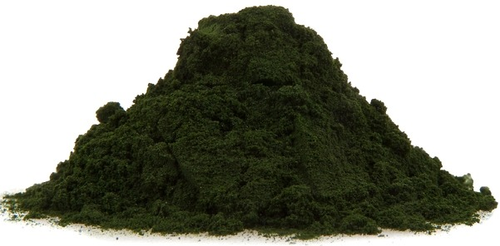
Chlorella Powder
Also Known As - Chlorella vulgaris Beij.
Origin - Taiwan Wild Crafted
Overview - Chlorella is a single celled algae that some scientists believe may be among the Earth's oldest living organisms, but it was only in the 1960's that Japanese scientists began to study chlorella as a tool of good health. Natural health enthusiasts know chlorella well as an excellent source of general nutrition. The Chlorella offered by Mountain Maus Remedies has a cracked outer cell wall which is broken by a high impact cryogenic jet-spray process that pulverizes the algae wall for enhanced digestibility. It is grown in outdoor secluded ponds in one of Japan's two primary reef areas and is fully protected from industrial pollutants.
Parts Used - The entire plant, dried. The cell wall is practically impenetrable and indigestible in most regards. When purchasing Chlorella, make sure the outer cell wall has either been cracked or opened.
I knew we wanted to offer chlorella under our own brand name, but I had heard rumors of chlorella from some sources being contaminated with heavy metals, pesticides and even pharmaceutical residues. I began asking around and quickly discovered that no one had done laboratory tests on a broad selection of chlorella to determine contamination levels of chlorella from different countries and sources. This surprised me, and I decided to take on the task myself.
I proceeded to purchase chlorella from 17 different sources, some were chlorella supplements purchased at retail, and others were chlorella purchased directly from importers and suppliers. I took the chlorella from each source, placed it in a new Ziploc bag and affixed it with a label containing a letter and a number such as "N03" or "M01." I did this myself, changing my latex gloves between samples, to make sure it was done right. Then I had all these samples sent to a reputable laboratory specializing in the detection of metals in food products.
The tests I ordered for each sample were:
• Aluminum (1.0 ppm detection limit)
• Arsenic (0.20 ppm detection limit)
• Cadmium (0.05 ppm detection limit)
• Lead (0.10 ppm detection limit)
• Mercury (0.05 ppm detection limit)
The 17 sources of chlorella boiled down to just 10 unique sources, as some of the different brands turned out to be from the same source. Those unique sources had the following countries of origin:
• 3 sources from China
• 3 sources from Taiwan
• 3 sources from Japan
• 1 source from Korea
(We did not test sources from India or any other country for this study. Nearly all the commercially-sold chlorella available today comes from China, Taiwan, Japan or Korea.)
In our research, we reached ten significant findings. Every person who consumes chlorella should be aware of these ten things:
Finding #1) There is no detectable mercury contamination in any chlorella.
This is good news. Our tests found no detectable mercury in any of the chlorella samples, even the chlorella from China.
This result is actually a little surprising, given how strongly chlorella binds to mercury. You would think that chlorella grown outdoors, downwind from coal-fired power plants, would accumulate mercury, but our tests showed zero detectable mercury in ALL samples.
Finding #2) Chlorella from China was the most contaminated
We found that chlorella from China was consistently more contaminated with metals than any other source. The average metals contamination found in our lab tests across the three sources from China was:
• Aluminum: 29 ppm
• Arsenic: 0.89 ppm
• Cadmium: 0.17 ppm
• Lead: 0.27 ppm
Note that Arsenic, Cadmium and Lead are all under 1 ppm and therefore only "trace" levels. These do not concern me, as there is far more arsenic in apple juice, for example, and there's probably more cadmium and lead in many types of seafood than in chlorella from China.
But the one number here that does concern me is the aluminum concentration. Given that aluminum intake is something most people seek to avoid, it seemed important to document the aluminum levels in various sources of chlorella.
Granted, there is aluminum in lots of other foods and supplements, but chlorella is specifically taken by people looking to remove metals from their bodies, not introduce yet more metals into their digestive tract. So this number of 29 ppm alarmed me, and I decided after seeing these results that I would never sell chlorella grown in China because I didn't want my readers eating 29 ppm of aluminum.
This was a big decision because China-grown chlorella is by far the cheapest source on the market. Thus, it has the highest profit margins of all chlorella. And as I later discovered, it is precisely this China-grown chlorella that is being widely promoted by many health websites across the internet. It's also used in many superfood formulations that have chlorella as one of their ingredients.
Finding #3) Even "Organic" chlorella from China was far more contaminated than non-organic chlorella from other countries
Here's the real shocker in this: According to our lab tests, the highest concentration of aluminum was found in a certified organic chlorella grown in China.
That sample tested at 33 ppm Aluminum, the highest of all our tests. And remember, this chlorella is sold in the USA as USDA certified organic chlorella.
By comparison, the non-organic chlorella produced in Korea showed zero detectable Aluminum.
In essence, our lab tests revealed that when it comes to chlorella, certified organic doesn't necessarily mean cleaner chlorella. In fact, the cleanest chlorella we found wasn't certified organic at all.
You might wonder: How can this be? Doesn't organic mean clean? No! Organic certification is the certification of a growing process, not an end result. You can follow organic practices, but if you're growing chlorella right next to a chemical plant, for example, you're going to get some cross-contamination in the soil, the air, or the water that's used to grow chlorella. Your chlorella can still be 100% certified organic even though it's far more contaminated with metals than non-organic chlorella.
This is an important distinction because most people equate organic with "clean." But that's a huge mistake, because with chlorella, the country of origin seems to be far more important than whether it's organic or conventional.
Organic certification does not require testing for heavy metals, by the way. A product can be heavily contaminated with aluminum, lead and even mercury and still be certified "organic" by the USDA.
Disclaimer - These products are not intended to diagnose, treat cure or prevent any disease. Reviews are not intended as a substitute for appropriate medical care or the advice of a physician or another medical professional.
1 Review Hide Reviews Show Reviews
-
This is high quality Chlorella
With this and your Spirulina powder taken together, I have so much energy, I'm not sure what to do with myself. The brain fog has also gone. I'll be getting this again